Monster Survivors
- 4.0
- Rating
- 10.00M
- Installs
- Free
- Price

 Analysis by App-foxy
I went into Monster Survivors expecting a quick casual game, but its roguelike parkour setup gives each short session more urgency than the bright presentation first suggests. You guide a character through danger, keep moving, and try to turn a fragile early run into a successful escape. It is easy to understand at a glance, yet the decisions become more interesting once several threats compete for your attention.
This is a free Android game from VOODOO, listed in the casual category and aimed at a Teen audience. It has reached over 10 million installs and holds a 4.0 average from around 106 thousand ratings, so it clearly appeals to a broad audience without pretending to be a deep, traditional action RPG. I would describe it as a good fit for players who want immediate movement, repeated attempts, and a little pressure in a compact format.
What the first session really feels like
The store summary calls it an epic adventure roguelike parkour game, while the short description presents it as Monster Survivors. In practice, that combination matters: the game is less about slowly building a permanent hero and more about making the most of the run in front of you. The parkour angle gives movement a central role, while the monster-survival theme keeps the screen feeling active and occasionally tense.
You May Also Like

 Blood Strike: 2.5 Anniversary
Blood Strike’s Loadouts Turn Every Drop Into a Tactical Gamble
A close look at Blood Strike’s custom loadouts: how fast access to signature weapons reshapes its battle royale rhythm, rewards preparation, and narrows the gap between fights.

 Pandora - Music & Podcasts
Pandora’s Music Is Easy to Start, but Harder to Recover
Pandora’s strength is its low-effort path from a seed to a station. Its weak spot is how much confidence it asks you to place in connection, setup, and quiet recovery.

 8 Ball Pool
 Is Built on Rivalries, Rematches, and Routine
A close look at the rivalries, rematches, shared routines, and unanswered safety questions that turn a quick pool match into a persistent mobile community.

 Samsung Music
’s Quiet Strength Is Playing What You Already Own
Its reach comes less from spectacle than from dependable access to a personal library. That simplicity is both the app’s strongest retention engine and its ceiling.

 AccuWeather: Weather Radar
AccuWeather Review: A Quick, Clear Forecast for Everyday Decisions
For everyday plans, the best forecast is the one you can understand quickly. AccuWeather makes rain timing, radar, and local conditions easy to act on, with a few trade-offs.

 Hill Climb Racing
Why Hill Climb Racing Still Turns Crashes Into One More Run
A tiny car, a bumpy hill and one more upgrade: Hill Climb Racing keeps resurfacing because its simple chaos makes every near-miss feel personal.
More From Our News Desk



I like that the basic appeal is immediate. You do not need a long explanation to understand the goal of staying alive and progressing through hazards. The challenge comes from reacting quickly, choosing when to take a risk, and learning which situations are worth pushing through. That makes it suitable for a spare moment, but it also creates the familiar roguelike temptation to try “just one more run” after a disappointing finish.
The casual label is accurate in terms of accessibility, not necessarily in terms of calmness. A new player can start without studying a complicated rulebook, but the action can still punish hesitation. If you prefer games where every outcome is predictable and failure is rare, this may feel more demanding than its category suggests. If you enjoy learning through repetition, the pressure is more likely to feel motivating.
One useful way to approach it is to treat the opening attempts as practice rather than tests of skill. Early failure tells you how quickly danger develops, how much room you need to maneuver, and when a shortcut or risky movement is more trouble than it is worth. That mindset makes the first session less frustrating and helps you notice improvement even before you complete a particularly strong run.
Installing it without overthinking the choice
The game is free to install, although optional in-app purchases range from $1.99 to $99.99 per item. I would begin with the free experience and decide later whether anything extra genuinely improves your enjoyment. There is no good reason to spend immediately in a game built around repeated attempts, especially while you are still learning its movement and timing.
Compatibility is broad enough for many older devices because the minimum requirement is Android 8.0. On a first launch, I would still close demanding background apps and make sure the phone has comfortable free space, particularly if you plan to play for longer stretches. Those are simple habits, but they reduce the chance that a casual session becomes annoying because of avoidable interruptions.
The current version is 2.7.0. I would let the game finish loading before judging the pacing, then spend the first few minutes learning the control response rather than chasing a high result. The most important setup decision is not a menu option; it is choosing a comfortable grip and keeping enough of the screen visible for quick reactions.
For a first-time player, the best starting routine is deliberately simple:
- Begin a run with the goal of understanding movement, not winning immediately.
- Watch the space around the character instead of staring only at the nearest monster.
- Use the early section to learn how much room a turn or jump needs.
- After a failure, identify one specific mistake before starting again.
This approach prevents a common mistake in casual action games: changing everything after every loss. If you alter your route, timing, and play style at once, you cannot tell what actually helped. Keeping one variable stable makes the learning curve much clearer.
The first meaningful success
My advice for reaching an early success is to value safe positioning over dramatic movement. Parkour games naturally encourage you to move quickly, but speed without a clear landing or escape route can place you directly into the next threat. I found it more useful to look one step beyond the immediate obstacle and ask where the character will be afterward.
That small change in attention is one of the game’s less obvious lessons. The nearest monster is not always the most important problem. Sometimes the real danger is the narrow space you are about to enter, the blocked direction behind you, or the loss of room needed for the next maneuver. Thinking in terms of an escape path makes the action feel less random.
When a run begins well, resist the urge to become reckless simply because you have survived the opening. A strong start is useful information, not permission to ignore danger. I prefer to keep a steady rhythm, take the route I understand, and only experiment when the surroundings give me enough room to recover from a mistake.
Another practical tip is to use the first successful section as a reference point. Notice what made it work: perhaps you avoided cutting too close to a threat, waited for a clearer opening, or stopped making unnecessary movements. Repeating that successful behavior is more valuable than trying to imitate a flashy run you cannot yet control.
The first real breakthrough comes from controlling panic, not from moving constantly. That is especially important for players coming from endless runners, where continuous forward motion is often the entire strategy. Here, movement still matters, but awareness and restraint can be just as important as speed.
Where new players tend to get confused
The biggest source of confusion is the balance between the roguelike structure and the casual presentation. A player may expect steady, permanent progress after every attempt, then feel disappointed when a run ends without producing an obvious long-term reward. I would judge each attempt on two levels: what it achieved in the game and what it taught you about surviving the next one.
That does not mean every failure is automatically satisfying. Repetition can become tiring when you feel that the outcome depended more on an awkward situation than on a decision you understood. When that happens, take a break instead of forcing another attempt. Short-session games are at their best when you can return with a clear head, not when you grind through frustration.
Another confusion comes from treating the game like a pure parkour challenge. Movement is central, but the monster-survival theme means that route planning and threat awareness shape the result. A technically quick maneuver may still be a poor choice if it leaves you with no safe response. I would rather choose a slower, readable path than gamble on a movement I can only execute occasionally.
Players may also wonder whether the Teen content rating means the game is unsuitable for younger casual players. I would use that rating as a reminder to check the store page and the device’s family settings before handing it to a child. For adults, the more relevant question is whether the monster-focused action and repeated failure fit their taste.
The purchase range deserves a calm response too. Because the game is free, you can learn its basic appeal before paying. If an item seems tempting, ask whether it changes a problem you genuinely enjoy solving or merely removes the tension that makes the run interesting. I would be cautious about spending more simply because a difficult attempt ended badly; frustration is a poor guide to a purchase.
How it compares with familiar casual alternatives
Compared with a standard endless runner, Monster Survivors feels more deliberate because survival is not only about maintaining forward momentum. Endless runners are often ideal when you want a nearly automatic rhythm: swipe, react, collect, and repeat. This game is better when you want the route and the surrounding threats to occupy your attention more fully.
Compared with a conventional action platformer, it is easier to pick up but less likely to offer the same sense of handcrafted progression. A traditional platformer may provide carefully designed stages, predictable checkpoints, and a clear campaign arc. This game’s appeal is in replaying the run, adapting to pressure, and improving your personal decisions rather than simply moving through a fixed sequence.
It also differs from slower role-playing games. If you want extensive character management, long conversations, or a story that carries the experience, this is probably not the right choice. Its strength is the immediate loop: enter the action, read the danger, make a movement decision, and try again after a mistake. That focus keeps it accessible, but it also limits the kind of depth it can provide.
For me, the best comparison is a short-form challenge game with roguelike tension. It works when I have enough attention for active play but not enough time for a long campaign. It is less suitable when I am looking for something relaxing in the background, because the need to monitor threats makes passive play a poor match.
Small habits that improve each run
First, avoid looking only at the character. Keep your attention slightly ahead of the action so you can prepare for what follows the current obstacle. This is a transferable skill within the game: once you stop reacting to the last problem and start reading the next one, the controls feel more manageable.
Second, separate experimentation from serious attempts. On an experimental run, test a risky route or unfamiliar timing without worrying about the result. On a serious run, use the safest choices you already understand. Mixing those purposes can make you feel inconsistent, when the real issue is that you were trying to learn and win at the same time.
Third, lower your session length when your reactions become rushed. Because the game is built around quick attempts, it is easy to keep restarting after a mistake. I have found that a short pause often helps more than immediate repetition. Returning with better focus can reveal that the problem was not a lack of ability but a tired decision-making rhythm.
Fourth, judge purchases by play value rather than by the size of the item. A large price does not automatically make an optional item useful, and a small purchase is not automatically necessary. Since the core game is free, the sensible order is to learn the loop, decide whether you enjoy the challenge, and only then consider spending.
Finally, use the game as a focused break rather than as background entertainment. A realistic everyday use is a ten-minute session while waiting for an appointment: start a run, concentrate on one improvement, and stop after you have learned something useful. That is a better fit than opening it during a meeting or while watching another screen, because divided attention works against the game’s main challenge.
Who should try it and who should skip it
I would recommend it to players who enjoy quick retries, movement-based challenges, and the satisfaction of turning a failed attempt into a better one. It is also a sensible choice for someone who wants a free casual game that can be understood quickly but still asks for attention once the action becomes crowded.
I would be more cautious if you dislike repeated failure or want a clear, uninterrupted story. Players who prefer relaxed matching games, long-form adventures, or carefully controlled platforming may find the roguelike repetition less rewarding. Likewise, anyone uncomfortable with optional purchase prompts should decide in advance to play without spending and use the device’s purchase controls where appropriate.
The game is not at its best when you need a completely predictable experience. Its appeal depends on responding to pressure and accepting that some runs will end earlier than hoped. If that sounds like a fair trade for replayability, the format has a lot to offer. If you want every session to deliver visible progress, a more conventional level-based game may suit you better.
My recommendation after learning the loop
Monster Survivors succeeds because it makes the first step easy and the next improvement personal. I can start without a long commitment, understand the basic objective, and then spend time refining how I read danger and choose movement. The roguelike structure gives failure a reason to exist, while the parkour focus keeps each attempt active rather than passive.
It is not a perfect match for everyone. The repeated-run format can wear thin, difficult moments may feel discouraging, and optional purchases mean I would play with a clear spending boundary. Still, those limitations are easy to recognize before committing money, since the game is free to try and its core appeal appears quickly.
VOODOO has made a casual game that rewards attention more than button mashing. My suggestion is to install it, treat the first few attempts as orientation, and aim for one controlled improvement instead of an immediate triumph. If you enjoy that process, Monster Survivors can become a dependable short-session challenge. If you need calm progression or a story-led adventure, choose a different casual game and skip the frustration.
FAQs for Monster Survivors
01What is Monster Survivors?
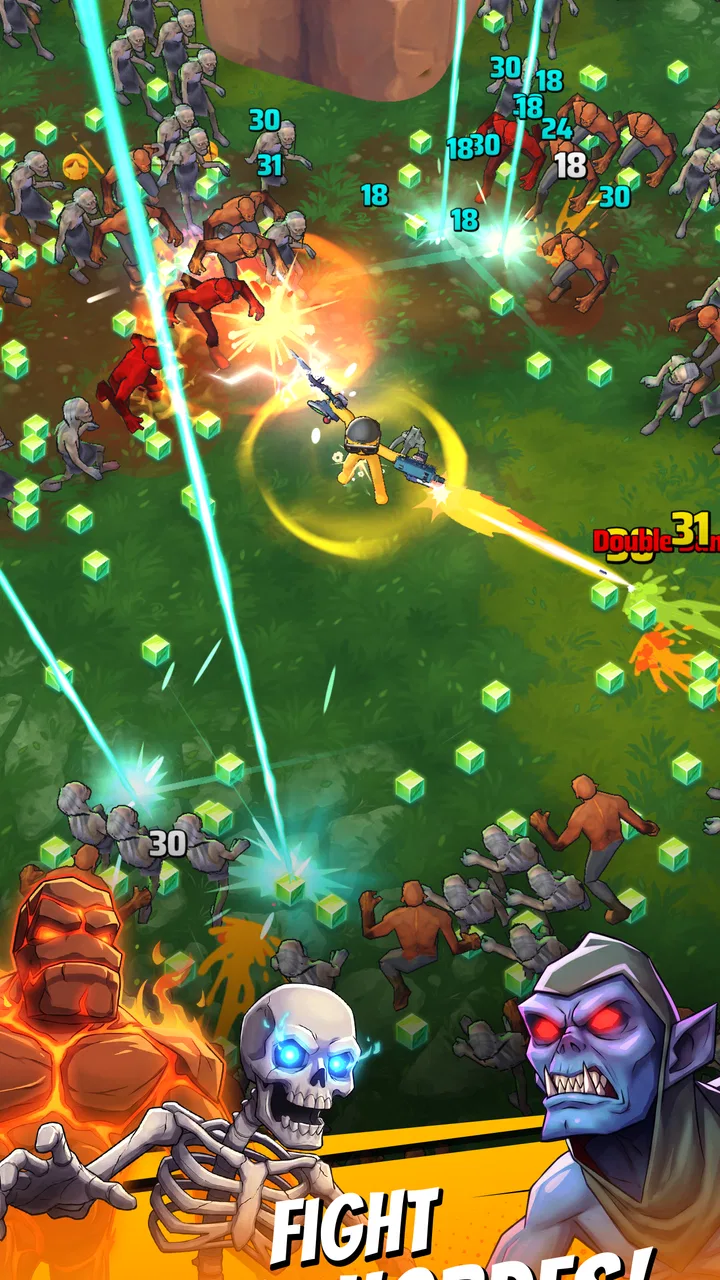
Monster Survivors is an action-focused survival game in which you control a hero surrounded by continuously spawning enemies. The main objective is to stay alive, collect experience, unlock and upgrade abilities, and defeat increasingly dangerous waves of monsters. Its simple controls make it easy to start, while the growing difficulty encourages strategic movement, smart skill choices, and repeated runs to improve your results.
02How do you play Monster Survivors?
Gameplay is built around moving your character through an arena while attacks and abilities help eliminate approaching monsters. During a run, defeated enemies usually provide experience or rewards that allow you to select upgrades. Choosing complementary abilities, avoiding being surrounded, and managing the space around your character are essential. Each attempt becomes more challenging, so learning enemy patterns and improving your build is important.
03Is Monster Survivors free to download and play?
Monster Survivors can generally be downloaded for free on supported mobile devices, although the exact availability may depend on your region and platform. Like many free-to-play survival games, it may include advertisements, optional purchases, or other monetization features. You should check the store listing before installing to confirm current pricing, in-app purchase details, permissions, and whether an internet connection is required for particular features.
04Can Monster Survivors be played offline?
Some parts of Monster Survivors may work without a constant internet connection, especially the core survival sessions, but offline functionality can vary according to the version installed and the device being used. Advertisements, cloud saving, events, account features, and purchases may require connectivity. If offline play is important to you, test the game after installation and review its current store description for the most accurate information.
05Is Monster Survivors suitable for all players?
Monster Survivors is usually accessible to players who enjoy quick action, wave-based combat, and progression through repeated attempts. The controls are relatively easy to understand, but later stages can become demanding and may require patience, experimentation, and careful upgrade choices. Because it features monsters, combat effects, advertisements, and possible in-app purchases, parents should review the age rating and device settings before allowing younger players to download it.
Pros
- Fast-paced roguelike runs are easy to start and replay.
- Many weapons and upgrades support different survival strategies.
- Simple controls work well on mobile screens.
- Short sessions fit quick breaks or casual play.
- Progression gives each run a clear sense of improvement.
Cons
- Later waves can feel repetitive once familiar builds dominate.
- Difficulty spikes may frustrate players without strong upgrades.
- Random item choices can make some runs feel unbalanced.
- Visual effects may become crowded during intense battles.
- Some content or upgrades may require grinding to unlock.

Monster Survivors
Gallery